Discovering Imperfect Beauty in Japan’s Economic Paradox
(Exchange student from the University of Kent, United Kingdom)

OVERTURE
David Bowman came to Aoyama Gakuin University in the fall of 2024 seeking to understand what makes Japan’s economy so distinct from the rest of the world. Born in Chile and raised in the UK, David chose to immerse himself in Japan not just through textbooks, but also through enrolling in economics courses taught in Japanese in the spring of 2025, as well as seeking out an internship at a Japanese corporation. His journey reveals how approaching challenges with curiosity and patience can transform obstacles into opportunities for both professional and personal growth.
Finding beauty in the “boring” world of economics
My fascination with understanding how societies work began early, sparked by countless World War II documentaries my father watched when I was young. History captivated me—the rise and fall of nations, the decisions that shaped our world, the human stories behind major events. But when it came time to choose a university path, I faced a practical reality: history, as fascinating as it was, wouldn’t easily pay the bills.
Economics initially felt like a sacrifice, a compromise between intellectual curiosity and practical necessity. I’ll be honest—economics can be an absolutely boring subject. The endless graphs, the mathematical models, the abstract theories that seem disconnected from real life. But I made a conscious choice early on: I could spend four years studying it miserably, or I could choose to be curious. I decided to approach every equation, every model, every theory with genuine curiosity.
That choice transformed everything. What initially seemed like dry statistical analysis became a lens for understanding human behavior, societal progress, and the intricate mechanisms that drive our world. Economics, I discovered, tells the story of human choices and their consequences—not so different from history after all. It just uses numbers instead of narratives, graphs instead of timelines. And once I learned to read those graphs like stories, I found unexpected beauty in this “boring” subject.
Examining Japan through the lens of economic paradox
There’s a famous quote by economist Simon Kuznets that there are “four types of economies: developed, underdeveloped, Japan, and Argentina.” This statement stopped me in my tracks. Here was Japan, the world’s fourth-largest economy on paper, yet considered so unique that it defied conventional categorization. What made Japan so different to warrant its own category?
The more I researched, the more fascinated I became. Japan’s economy seemed to operate on different principles than those my textbooks described. It had the rigid labor market that should theoretically stifle innovation yet also had companies that pioneered just-in-time manufacturing. There were the decades of low growth that should signal decline, yet there was also a society that maintains remarkable stability and quality of life. A nation that seamlessly blends traditionalism with innovation in ways that shouldn’t work according to economic models, but somehow do.
Beyond the economics, Japan had always existed in my periphery through different channels; be it through its cuisine, which is far more delicious than the UK’s, the Pokémon games I’d played as a child, or my brother introducing me to anime in secondary school. There were also the images of pagodas and temples alongside nature that I’d seen online, showing architecture that complemented rather than conquered its environment.
All of these elements—the economic enigma, the cultural richness, the aesthetic philosophy—painted a picture of a country that had found its own path. I realized that understanding Japan’s economy meant understanding something deeper about how societies can develop along entirely different trajectories and still thrive. Statistics alone couldn’t capture this. I needed to experience it firsthand.
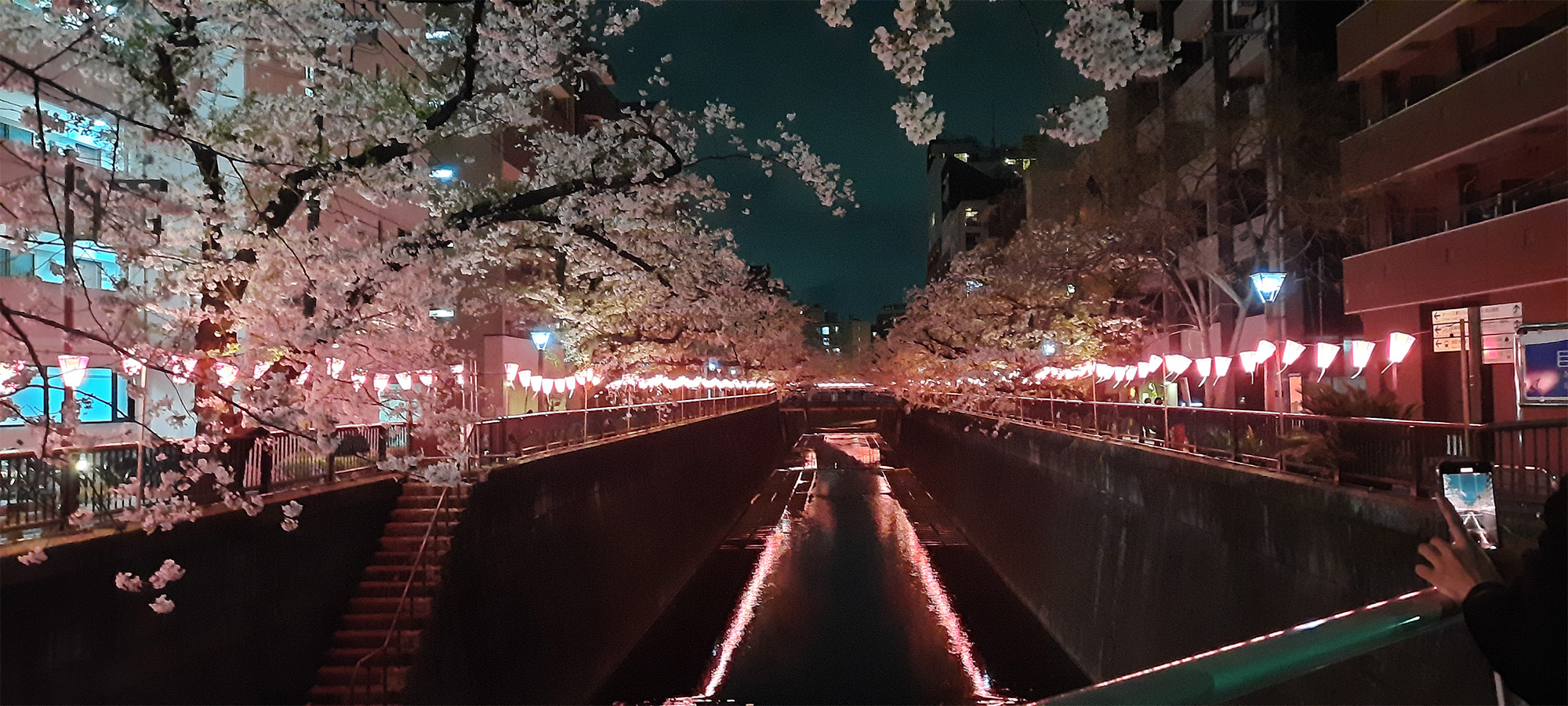 The Sakura trees by the Meguro River, decorated with gorgeous pink lights around the time of their full bloom. This became the highlight of my trip from home to the university whenever I commuted by bus.
Embracing the path to Japan and AGU
When applying to universities through the UK system, you get five choices for your course applications. At the University of Kent, I ended up choosing between “Economics with Financial Econometrics” and “Economics with a Year Abroad.” The year abroad option offered only three destinations: Germany, Spain, or Japan. The choice seemed obvious. I could study financial econometrics on my own time—and I do, finding it fascinating. But I couldn’t transport myself to Japan while sitting in a UK classroom. The opportunity cost calculation was a simple one: which experience was truly irreplaceable?
I was actually the first Kent economics student to choose the Japan exchange in about ten years, despite the program being available all that time. As I researched more about Aoyama Gakuin University (AGU), certain things stood out. The university’s Methodist roots dating back to the 1800s gave it a unique international perspective from its very foundation. Its location in Shibuya meant I could experience Tokyo’s urban intensity while studying. The campus itself, from what I could see online, was stunning—a green oasis in the heart of one of the world’s busiest cities.
But what truly impressed me upon arrival was how well AGU had thought through the entire international student experience. Rather than a one-size-fits-all approach, the International Center provided support that adapted to the needs of each student. If you wanted independence to find housing on your own, they gave you that freedom. If you needed translation help or guidance navigating Japanese bureaucracy, they provided that too. This flexibility meant me and my fellow international students could each craft our own experience while knowing support was there when needed.
Diving headfirst into Japanese-taught economics
When I tell people I’m taking economics courses taught entirely in Japanese with only six months of Japanese study beforehand, they usually think I’m either brave or foolish. Perhaps I’m both. But this challenge has become one of the most rewarding aspects of my time at AGU. Mathematical Statistics, Macroeconomics, Econometrics—these courses would be challenging enough in English. In Japanese, the challenge compounds. My professors were gracious and patient and, with self-study, I made sure to fill in content that I missed due to my limited Japanese ability.
My study routine became intense but oddly enjoyable. I’d attend the Japanese lecture, catching as much as I could. Then I’d plant myself in the library with an array of textbooks and online resources, reconstructing what I’d missed. Mathematical Statistics became particularly fascinating this way—the equations and figures told their own story, and I could work backwards from there to understand the Japanese explanations. Each topic required multiple hours of self-study to supplement the class time, but I was happy to make that investment.
A pleasant surprise was how this struggle enhanced rather than hindered my learning. When you have to work much harder to understand something, when you have to approach it from multiple angles and sources, you end up understanding it more deeply than if it had been handed to you easily. The Japanese examples and data also gave me perspectives I’d never have encountered in the UK, where our models primarily used British data and assumptions. Here, I was learning economics through Japan’s lens—deflation as a lived reality rather than theoretical concern, corporate structures that prioritize stability over quarterly profits, labor markets that operate on entirely different social contracts..
This immersive approach to learning economics in Japanese has been transformative. It’s taught me that with enough curiosity and determination, language barriers become speed bumps rather than walls.
 A picture from one of my "wandering" days, when I would just walk around Tokyo without a destination. Though it's an incredible waterfront area by the Sumida River, I probably shouldn’t have walked around during one of the hottest days of the year!
Learning the rhythm of Japanese business culture
During my spring break and summer vacation, I had the opportunity to intern at a major Japanese human resources corporation. Finding an internship as a foreign student with limited Japanese was challenging—I was incredibly fortunate to secure this opportunity and even more fortunate when they invited me back for a second stint.
The Japanese workplace was everything international commentators describe and yet nothing like it at the same time. Yes, the hours were long—but the environment was far from the soul-crushing stereotype that can be portrayed in Western media. My colleagues were warm and supportive, the work was engaging and relevant, and there was a genuine sense of purpose in even routine tasks.
What struck me was how the language barrier became manageable in the
workplace. Many of my colleagues had lived abroad—in California, Chicago, other
international posts—and could help translate when needed. When communication got difficult,
we’d resort to body language and context clues. But beyond this, there’s a universal
language of competence and effort. When you show up consistently, approach tasks with
curiosity, and demonstrate genuine engagement, communication finds a way.
This
experience taught me about Japanese business culture from the
inside—the
emphasis on consensus-building, the careful attention to detail, the long-term thinking that
prioritizes sustainable relationships over quick wins. As someone interested in finance and
banking, working in the “real economy” gave me invaluable perspective on how financial
markets connect to productive enterprises. Thanks to this experience, I learned of new ways
of approaching problems and insights into how business can be conducted with different
underlying values to those I’d learned in the West.
 A portrait of my general business attire during Summer as an intern, standing in front of Aoyama library. Given the heat, everyone was allowed to wear more breathable clothing, though I still chose to wear a tie as a personal gesture of respect.
How studying in Japan transformed my perspective on progress
My favorite Japanese phrase is shouganai—"it can’t be helped.” There’s something profound in this simple expression that captures a philosophy I’ve come to embrace during my time here. It’s not about giving up or being passive; it’s about accepting what you cannot control and moving forward regardless.
Living in Japan has fundamentally changed how I view progress and challenges. Before coming here, I looked at the UK’s problems—our housing crisis, our struggling public services, our political dysfunction—with frustration and growing resentment. Comparing the UK to idealized visions of other countries, it was difficult to find a bright side. Why couldn’t we have efficient public transport like Tokyo? Why couldn’t we solve problems that seemed so obviously fixable?
But living here, seeing Japan up close rather than through the filtered lens of admiration, has taught me something crucial: every country has its beautiful and ugly sides. Japan’s trains run on time, but the work culture can be arduous. The streets are safe and clean, but social pressures can be suffocating. The convenience stores are miraculous, but the resistance to change in certain areas can be frustrating. Japan has overcome problems the UK still struggles with, and the UK has solved issues Japan still faces.
More importantly, I’ve learned that progress is never a straight line upward. Reading about Japan’s post-war development, studying its economic history, living through its current challenges, I see that progress has always been messy, slow, and often indirect. Problems that seem permanent today might be solved tomorrow, but not in ways anyone expects. This realization has replaced my resentment toward the UK with patient optimism. The British buildings that I’d always considered an eyesore? They’re still ugly, but they represent progress—each one means people have homes. The problems we face? They’re real, but they’re solvable, even if solutions take decades rather than years. Looking at countries from afar, it’s easy to see only their successes. Living in that country teaches you that every society is a work in progress, beautiful and flawed in its own way.
Studying at AGU has given me more than economic knowledge or Japanese language skills. It’s given me perspective—the ability to step back and see the broader picture, to find beauty in imperfection, to approach challenges with curiosity rather than frustration. When I return to the UK, I’ll carry with me not just memories of temple visits and convenience store runs, but a fundamentally different way of seeing the world. The economics student who arrived in Tokyo looking for answers to Japan’s economic paradox discovered something more valuable: there are no perfect systems, no final solutions, only ongoing human efforts to build something better. And in that ongoing effort—messy, imperfect, sometimes frustrating—lies real beauty.
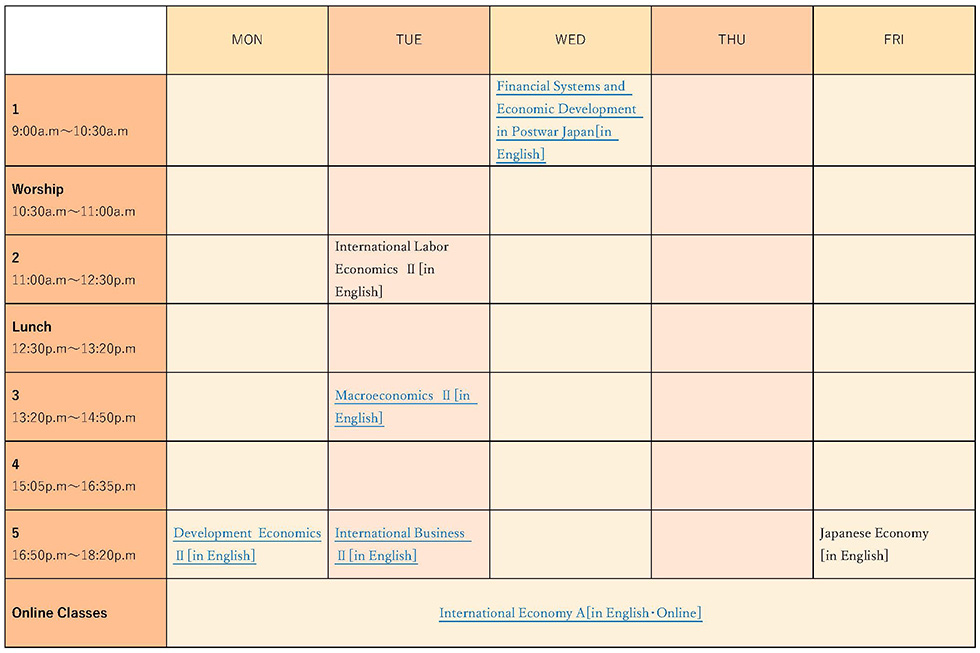

| MON | 5 16:50 p.m〜18:20 p.m | Development Economics Ⅱ[in English] |
|---|---|---|
| Online Classes | International Economy A[in English・Online] |
| TUE | 2 11:00 a.m〜12:30 p.m | International Labor Economics Ⅱ[in English] |
|---|---|---|
| 3 13:20 p.m〜14:50 p.m | Macroeconomics Ⅱ[in English] | |
| 5 16:50 p.m〜18:20 p.m | International Business Ⅱ[in English] | |
| Online Classes | International Economy A[in English・Online] |
| WED | 1 9:00 a.m〜10:30 a.m | Financial Systems and Economic Development in Postwar Japan[in English] |
|---|---|---|
| Online Classes | International Economy A[in English・Online] |
| THU | Online Classes | International Economy A[in English・Online] |
|---|
| FRI | 5 16:50 p.m〜18:20 p.m | Japanese Economy [in English] |
|---|---|---|
| Online Classes | International Economy A[in English・Online] |


Department Enrolled
Aoyama Gakuin International Center
The role of the International Center (IC) at Aoyama Gakuin University is to provide educational support related to the internationalization of the university as well as to help the development of students to become global citizens. The main work of the IC consists of supporting both students going overseas and international students from overseas partner schools and approved institutions; as well as assisting full-time, degree-seeking international students. The worldwide trend of globalization affects not only corporate activities and international relations but should also impact the structure of university education and curricular content. With that in mind, the IC strives to strengthen and expand collaboration between overseas universities and Aoyama Gakuin University while respecting the diverse cultures and traditions of each country as well as the customs and values of our students.