Walking into Japan Beyond the Pages
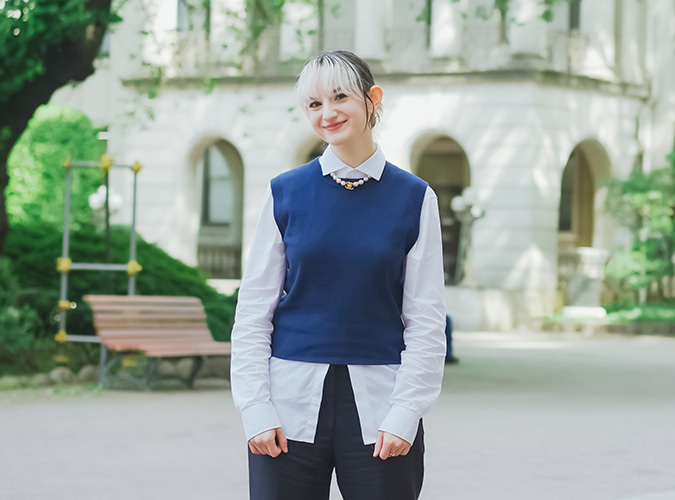
(Exchange student from the Taras Shevchenko National University of Kyiv, Ukraine)

OVERTURE
Yelyzaveta Khmarska arrived in Tokyo with a love for world literature. Studying Japanese at the National University of Kyiv, she immersed herself in the works of Japanese authors, seeking universal themes in Japanese narratives. At Aoyama Gakuin University, she is living amid what she’d only imagined through stories—discovering how literature serves as both a window and a bridge between cultures.
Unlocking connections through the written word
My relationship with Japanese culture began, like many, with anime flickering across a television screen in my childhood. But it was literature that truly captured my imagination and set me on the path that would eventually lead me to Tokyo. As a teenager, I stumbled upon films like Rashomon and Tokyo Story—old, black and white, with long stretches of silence that felt alien by modern standards. Yet something about those films stayed with me. I could recall specific scenes, the emotions they stirred, years after watching them.
When I entered university and chose to major in Japanese language and literature, I discovered a world of authors whose works resonated deeply despite the vast distance between Ukraine and Japan. Ryūnosuke Akutagawa’s Spinning Gears and Kappa left a strong impression on me early on. More recently, Ango Sakaguchi’s In the Forest, Under Cherries in Full Bloom and collections by Kunikida Doppo have stirred new thoughts about society and the human condition.
What draws me to Japanese literature is how authors engage with the world
around them. Take Natsume Sōseki’s Kokoro, for example. The novel is deeply connected to the
Meiji era and the collision of Western values withtraditional Japanese values. The
protagonist struggles with change in a rapidly transforming society—a feeling that resonates
universally, especially in times like ours. Yet the novel also contains elements that are
uniquely Japanese, reflecting a specific historical moment that other literatures simply
lack.
Through my studies, I’ve come to see literature as more than entertainment or
art. It’s a lens for understanding how different cultures process similar human experiences.
Even authors whose perspectives I disagree with have taught me something valuable, helping
me recognize parallels between societal concerns in Japan and Ukraine across the decades, or
revealing assumptions in my own worldview I hadn’t questioned before.
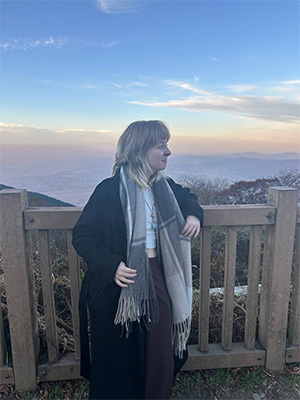 Overlooking the Kanto Plain from Mt. Tsukuba.
The path from Kyiv to Tokyo
When I was seventeen and deciding what to study at university, I knew I wanted to pursue languages. I had always been fascinated by linguistics, but choosing which language to study meant choosing an entire culture, history, and literature that would shape my academic path. The most common options in Ukraine are French, German, or English, languages I already had some exposure to. I wanted something different, something that would give me a completely new perspective on the world. That’s why I chose Japanese.
At the Taras Shevchenko National University of Kyiv, I spent three years studying Japanese language, literature, linguistics, and translation. Most of our classes were taught by Ukrainian professors who had lived or studied in Japan, and we also had access to native Japanese speakers and online exchange meetings with Japanese universities, including AGU. But I came to realize that textbook knowledge and live experience are fundamentally different. You can study a culture for a decade, but it still won’t give you the same understanding as being there, seeing it with your own eyes.
I had heard about AGU from other Ukrainian students who had studied here before me, and when I attended online exchange meetings with AGU students, I got a glimpse of what studying here might be like. Now that I’m here, I can confirm there are opportunities, courses, and ways of thinking at AGU that I simply wouldn’t find elsewhere. The library alone has been invaluable—I’m there almost every day, and I can always find the research materials I need, including works in English that I can’t find in Ukraine.
When literature becomes reality
Before coming to Japan, when I read novels set in Tokyo or Kyoto, the place names felt distant. I could look them up online, but it was difficult to visualize them. But now everything has changed. I have images in my mind of Tokyo neighborhoods and famous places I’ve visited in Japan. When an author mentions that a character spent half his life in Ginza, I can picture exactly what that means. The atmosphere, the streets, the feeling of the place.
Reading Japanese literature now feels like participating in it rather than observing from a distance. When authors describe certain experiences or emotions, I understand them on a deeper level because I am experiencing them myself. In fact, when I come across a location in a book, I add it to a list. I’m building my own reading map of Japan.
Traveling in Japan has been exciting. As a big Moomin fan, I loved visiting Moominvalley Park. And seeing Kyoto for myself, with its endless landmarks, really made it sink in that I was experiencing Japan first-hand.
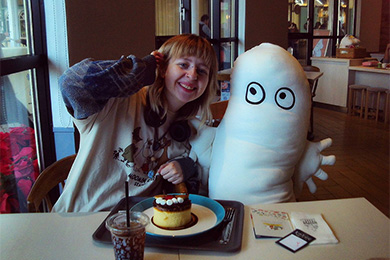 A long-awaited visit to Moominvalley Park.
But one of my favorite experiences was in
Utsunomiya, the capital of Tochigi Prefecture. I was just passing through as part of a
longer trip, but the city reminded me of my hometown of Dnipro, a city with skyscrapers and
busy streets, but filled with people just living their daily lives. When I walked into the
city center, I found a quieter area with a temple where there were no tourists, just locals,
and a peaceful tree-lined promenade.
What I loved about Utsunomiya was that it felt like an ordinary city with
ordinary people, not a tourist destination. The memory of simply walking those streets makes
me as happy as visiting the famous spots. Sometimes it’s the quiet, observant moments that
resonate most deeply.
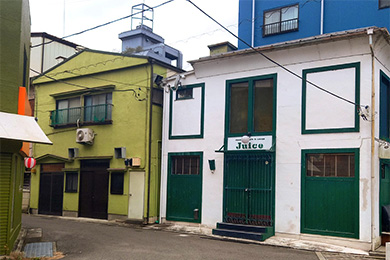 A memorable scene in Utsunomiya— everyday life quietly continues behind a retro facade.
Cultural exchange goes both ways
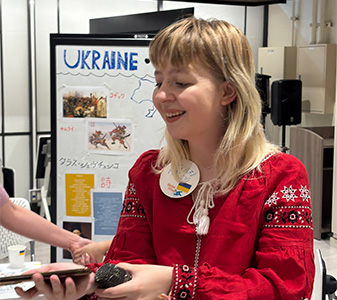
One of the most rewarding aspects of my time at AGU has been the opportunity to share Ukrainian culture while learning about Japan firsthand. At the Global Village cultural exchange event on campus, two other Ukrainian students and I set up a booth where visitors could write their names in Cyrillic script, leave messages in a “wishing boot,” and try Ukranian oat cookies. We created displays showing similarities between Ukraine and Japan, like the parallels between Japanese samurai and Ukrainian Cossacks, and the cultural significance of cherry trees in both countries—the Vyshnya in Ukrainian poetry, especially in the works of Taras Shevchenko, and the sakura that’s so central to Japanese culture.
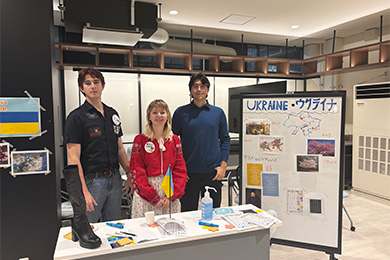 Taking part in Global Village wearing a vyshyvanka, the traditional Ukrainian embroidered shirt.
The highlight of that day was teaching a group of kindergarteners a traditional Ukrainian circle dance called Podolianochka. I was quite nervous beforehand, but the children learned incredibly quickly and were so enthusiastic. They all wanted to be the person in the center of the circle. Seeing Ukrainian traditions bring joy to Japanese children was a moment I’ll always treasure.
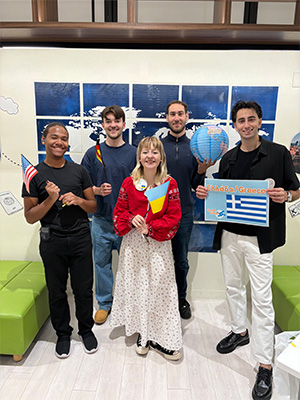 Interacting with international students from various countries at Global Village.
The International Commons has become one of my regular gathering places, hosting frequent events that make it easy to connect with both international and Japanese students. I’ve been pleasantly surprised by how open Japanese students are to communicating with exchange students. Having Japanese friends has enriched my experience immensely—when I travel around Tokyo or explore the city with them, I feel less like a tourist and more like I’m genuinely part of life here. I’ve also joined AGU’s official coffee circle, “Coffellow Mellow Aoyama,” which has offered a wonderful way to experience Japanese culture from a perspective beyond academics. At the International Commons “Coffee Workshop,” I supported the event as a circle member; after listening to a lecture from a coffee professional, we brewed hand-drip coffee on site and served it freshly made to the participants. These kinds of extracurricular activities have been a great opportunity to meet new people and build friendships.
Learning to question assumptions
Living in Japan has given me the chance to see how my own knowledge and experiences fit into a larger picture. Growing up in Ukraine, forming my own national identity, and gaining an understanding of my own country’s history and struggles has been deeply formative, and being here has not changed any of that. What it has done is open doors to perspectives that I simply couldn’t access from home.
Some particularly enlightening moments came through exploring a number of topics in my Japanese Politics Ⅱ [in English] class. Ukraine and Japan have their own unique geographical traits, cultures, and histories, and while my upbringing in Ukraine has shaped my understanding of the various political issues facing each country, learning about Japanese politics has shown me how differently the same issue can be understood depending on a country’s context. Topics such as energy and defense policies are nuanced, but being in these classrooms and talking with people whose lives have been shaped by entirely different circumstances has helped paint a fuller picture in my mind of the diversity of human experiences.
This is what I mean when I say I want to contribute to education in Ukraine in the future. Studying Asian culture and coming to Japan has enriched my worldview tremendously. I want to help others in Ukraine discover what I’ve been discovering here: that engaging deeply with how others see the world doesn’t take anything away from who you are—rather, it gives you a fuller sense of your own place within the world. I want to encourage others to search deeper and look further, to recognize that while people everywhere share fundamental human experiences, the contexts that shape our responses vary enormously.

Gaining courage through language and experience
The language barrier has been its own form of learning. In Ukraine, I understood Japanese grammar well and could read complicated texts, but producing spoken Japanese was always difficult. I was terrified of speaking.
This newfound confidence extends beyond language. I remember the first time I
visited a temple. I was confused what to do and couldn’t bring myself to enter. But I don’t
let anxiety win anymore. I walk into unfamiliar places, ask for instructions when needed,
and try things I haven’t done before.
While I plan to spend my professional life in Ukraine because I feel a deep
connection to my own culture, I would love to return to Japan in a few years to work here
and deepen my understanding. Right now, I know there are many things beyond my reach simply
because I’m not fully fluent in Japanese. I’d like to come back when I’m more confident,
perhaps to share Ukrainian culture with Japanese people more effectively, or to learn what
it truly means to be part of broader Asian society.
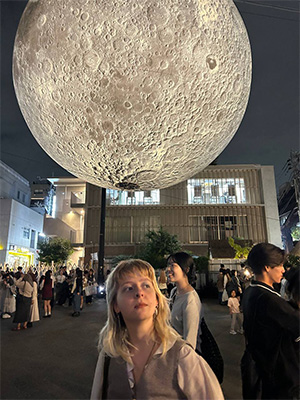 The symbol of “Moon Art Night Shimokitazawa 2025”: Museum of the Moon by Luke Jerram, a seven-meter-wide replica Moon with craters rendered in fine detail.
Coming to Japan has also inspired me to be a better tourist in my own country. Here, I’ve discovered I enjoy traveling alone, seeking out places that reflect Japanese culture. If I can do that here, I can do the same with Ukrainian culture. I’ve already started planning trips to explore Ukraine more thoroughly when I return.
As I reach the halfway point of my exchange and look toward my return home, I carry with me something more valuable than any single fact or skill. I’m learning to hold multiple truths at once. To understand that assumptions that work in one context may not apply in another, that human experiences connect us even as our responses differ, and that real understanding requires not just reading about a culture but living within it—making mistakes, asking questions, and remaining open to having your perspective challenged and expanded.
The locations in Japanese novels are no longer just words on a page—they’re streets I’ve walked, neighborhoods I’ve explored, atmospheres I’ve felt. The questions raised in Japanese literature about change, identity, tradition, and modernity are no longer abstract themes but lived realities I encounter daily. This is what it means when literature becomes reality, and reality, in turn, enriches literature.
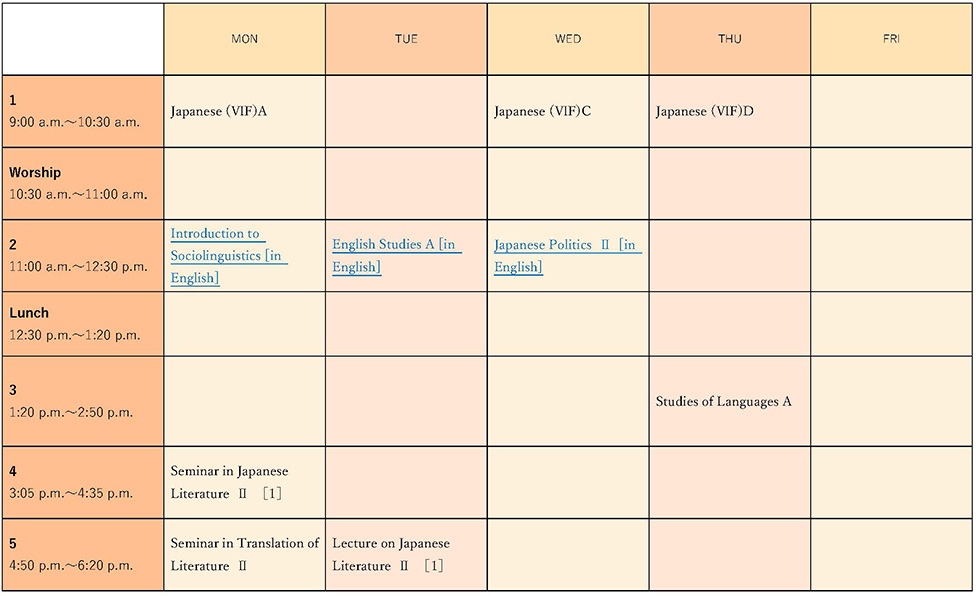
| MON | 1 09:00 a.m〜10:30 a.m | Japanese(ⅥF)A |
|---|---|---|
| 2 11:00 a.m〜12:30 p.m | Introduction to Sociolinguistics [in English] | |
| 4 15:05 p.m〜16:35 p.m | Seminar in Japanese Literature Ⅱ [1] | |
| 5 16:50 p.m〜18:20 p.m | Seminar in Translation of Literature Ⅱ |
| TUE | 2 11:00 a.m〜12:30 p.m | English Studies A [in English] |
|---|---|---|
| 5 16:50 p.m〜18:20 p.m | Lecture on Japanese Literature Ⅱ [1] |
| WED | 1 9:00 a.m〜10:30 a.m | Japanese(ⅥF)C |
|---|---|---|
| 2 11:00 a.m〜12:30 p.m | Japanese Politics Ⅱ [in English] |
| THU | 1 09:00 a.m〜10:30 a.m | Japanese(ⅥF)D |
|---|---|---|
| 3 13:20 p.m〜14:50 p.m | Studies of Languages A |
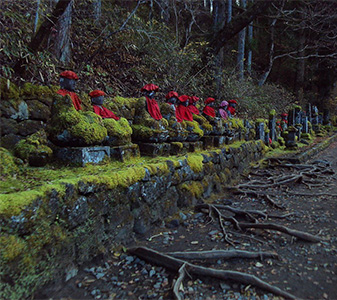
Department Enrolled
Aoyama Gakuin International Center
The role of the International Center (IC) at Aoyama Gakuin University is to provide educational support related to the internationalization of the university as well as to help the development of students to become global citizens. The main work of the IC consists of supporting both students going overseas and international students from overseas partner schools and approved institutions; as well as assisting full-time, degree-seeking international students. The worldwide trend of globalization affects not only corporate activities and international relations but should also impact the structure of university education and curricular content. With that in mind, the IC strives to strengthen and expand collaboration between overseas universities and Aoyama Gakuin University while respecting the diverse cultures and traditions of each country as well as the customs and values of our students.