From Corby to Tokyo by Way of Many Languages

OVERTURE
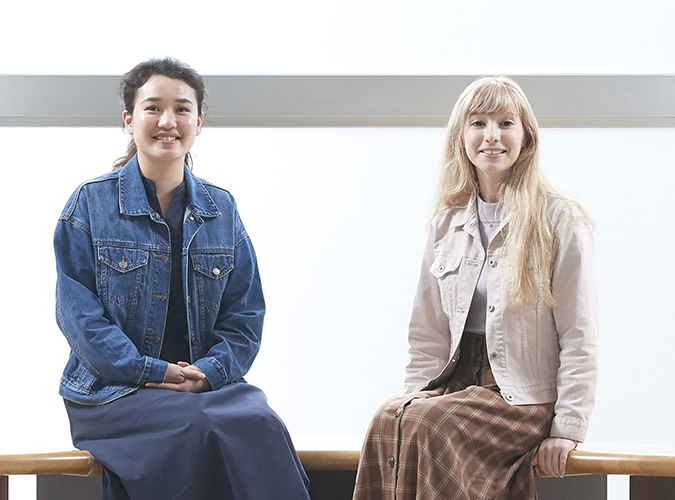
Born in Poland and raised in the UK, Jagoda has lived between languages and cultures her whole life. Bilingual in Polish and English, she has dabbled in everything from Italian to Korean, and now studies Japanese at Oxford Brookes University. Throughout her year at Aoyama Gakuin University, Jagoda discovered that immersion brings its own quiet rewards, and has given her a kind of independence.
Growing up between two European homes
I was born in Poland, but my parents moved our family to the UK when I was just one year old, and I’ve lived there ever since. My hometown of Corby, in the English countryside, has been the backdrop for my entire schooling. At the same time, Poland has always remained very much a part of who I am. We speak Polish at home, and every year my family visits relatives there, so I’ve grown up moving fluidly between two languages and two ways of life.
Those annual visits shaped me more than I realized at the time. We would usually drive to Poland from the UK, passing through France, Belgium, the Netherlands, and Germany along the way, sometimes extending the trip down to Italy through the Czech Republic, Austria, and the Alps. Long before I ever thought about Japan, I’d already developed an instinct for what it feels like to be a stranger passing through somewhere unfamiliar, ordering food with hand gestures, and picking up the rhythm of a place you only partially understand.
That early exposure also gave me a fascination with languages that has never really left me. From around age 11, when our family first visited Italy, I wanted to learn Italian. Later I tried German, French, and more recently bits of Korean ahead of a weekend trip to Seoul. I have a habit of starting languages and then moving on to the next one, but I’ve come to see that as its own kind of education. Speaking a language outside of English from childhood has made my ear more flexible, and I genuinely believe it helped me with Japanese pronunciation—Polish has a rolled “r” and consonant clusters that prepare your mouth for sounds English speakers often struggle with.
Springing from anime into a degree
Like many of my generation, my first real exposure to Japan came through anime. I remember being struck by how the language sounded—how smoothly it flowed, without the sharp edges of English or the harsher consonants of Polish. The school I attended only offered French and Spanish, languages relatively close to English, and I wanted to learn something fundamentally different. Japanese fit the bill.
One anime that stayed with me was Free!, a slice-of-life series following a group of high school swimmers. It wasn’t just the story that captivated me; it was the way the show depicted everyday life in Japan—the walk to school, the routines of student life, the quiet textures of an ordinary day. I’d later learn that some scenes in Free! looked very similar to locations at Aoyama Gakuin University, which felt like a strange coincidence when I eventually arrived on campus and recognized the courtyard and the gates from the background of a show I had watched years earlier.
At age 16, in my sixth-form years, I started teaching myself the basics. I watched YouTube tutorials on hiragana and katakana, printed out my own worksheets, and pinned them to my bedroom wall to memorize the characters in my free time. It wasn’t goal-oriented at the time—I just enjoyed it. After that, I took a gap from Japanese while figuring out what to study at university. Initially, I had thought about going into acting. I’d spent years on creative endeavors: drawing since I was a kid, doing dance (ballet, hip hop, K-pop), musical theatre, and art at GCSE and A-level. But the more my parents and I talked it through, the more it became clear that acting wasn’t quite the right fit. They suggested I think about Japanese, since I had already built a foundation from my self-studying. When I looked into the Japanese Studies course at Oxford Brookes University and saw that a year abroad was part of the degree, something clicked. That was the deciding factor.
Over two years at Oxford Brookes, I gradually built up the language alongside content modules on Japanese history, religion, and film. The film module in particular caught my interest, and it covered the gamut from classics to modern films. Conversation practice came largely through weekly oral skills classes that gave us chances to have video call exchanges with Japanese students, including those preparing to come to Oxford Brookes.

Setting my sights on Tokyo and AGU
When the time came to choose where to spend my year abroad, my university offered about sixteen partner institutions in Japan. My first instinct was Kyoto—the historic capital, the temples, and the more traditional atmosphere. But the more I thought about it, the more I realized I wanted to experience city life. I had grown up in the small town of Corby and studied in Oxford, neither of which had prepared me for the scale of a megacity. So I shifted my focus to Tokyo and started narrowing down the options there.
AGU rose to the top of the list for a personal reason: a friend from AGU who was on exchange in the UK suggested it to me. She told me about the clubs, the excellent location, and the campus itself, and when I started looking into it, everything she said checked out. I was drawn to the convenience of the Aoyama campus, sitting right at the heart of one of Tokyo’s most dynamic neighborhoods, and the architecture also caught my eye. The range of courses offered in English meant I could continue to take classes aligned with my interests beyond just Japanese language study.
What I couldn’t have anticipated before arriving was how comfortable the campus would quickly feel. The International Commons became my anchor almost immediately. I love the atmosphere there—it’s modern but warm, with a lot of wood, a calm feel, and a steady mix of international and Japanese students. It’s where I spend most of my free time between classes, often with friends.
 A fun evening with friends at an izakaya near my dorm.
Reading the unwritten rules of life in Japan
The culture shock I experienced on arrival was less about any single thing and more about a hundred small adjustments. Talking on the train, talking on the phone in public, eating or drinking while walking—these are everyday acts in the UK that are quietly discouraged here. I had a Japanese friend once tell me that the UK has many rules, which surprised me because as a local I’d never noticed them. Coming to Japan flipped that around: suddenly the rules were everywhere, and they were not mine.
Adapting to most of them came naturally. I’m not someone who makes frequent phone calls or speaks loudly on public transport, so the quietness of Tokyo’s trains has been a relief rather than a constraint. The other rule that occasionally trips me up is the strict observance of pedestrian crossings—not crossing on red even when the road is empty. If I’m running late for class, I sometimes have to fight the urge.
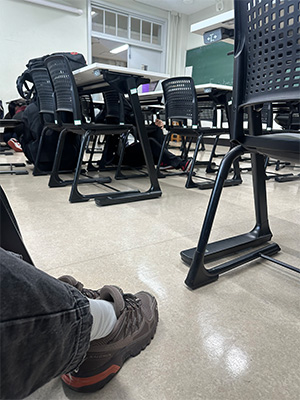 An Earthquake Early Warning drill held during class shortly after I arrived in Japan. Having grown up in the UK, where earthquakes are relatively rare, it was a uniquely Japanese experience for me.*
*A “ShakeOut” drill that uses Japan’s Earthquake Early Warning system to teach people how to protect themselves during an earthquake.
When I went back to the UK over the winter break, I noticed I had picked up the habit of doing small bows when I was thanking people, and I caught myself saying “please” and “thank you” more than my friends. Another time, the non-smoking etiquette of Japan had become so ingrained in me that I nearly scolded my friend for pulling out a cigarette outside, before remembering that he wasn’t breaking any rules by UK standards. Those flashes of reverse culture shock were oddly comforting, a sign that Japan had genuinely become part of how I move through the world.
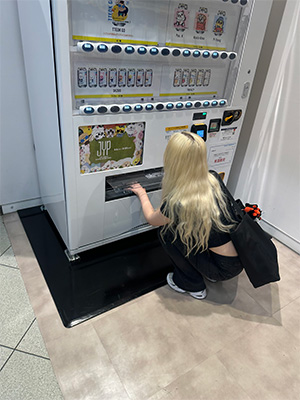 Vending machines exist in the UK too, but I had never seen one selling fan merchandise. I was surprised by how vending machines in Japan are part of everyday fan culture.
The classes I’ve most enjoyed here at AGU have surprised me. Last semester I took British Thoughts and Cultures Ⅱ, which focused on British country houses and readings from Jane Austen’s Pride and Prejudice and Northanger Abbey. Pride and Prejudice has been one of my favorite novels for years, so the class was a joy. It was also interesting to be the only British student in the room while my Japanese classmates studied my own country, and I had plenty of chances to share my experiences. This semester I’m taking Lecture on English Culture Ⅰ(1), which has turned out to focus on Shakespeare’s Hamlet, and a continuing Media Studies Ⅰ [in English] class tracing the history of human communication, from the time of cave paintings to the present day. The Shakespeare class has been particularly intriguing because the framing places more weight on religious imagery and interpretation than my schooling in the UK ever did, a unique angle that may reflect AGU’s Methodist heritage.
The Japanese language classes, I will admit, have been a bit challenging. It has required adjustment, but the studies are paying off and I’ve felt my speaking and listening improve in everyday situations outside the classroom—at convenience stores, at restaurants, and in casual conversations with Japanese students on campus.
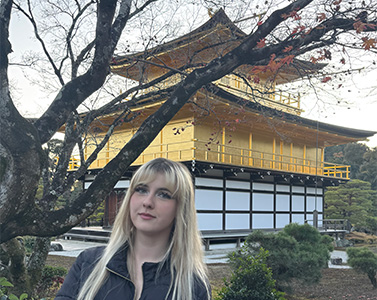
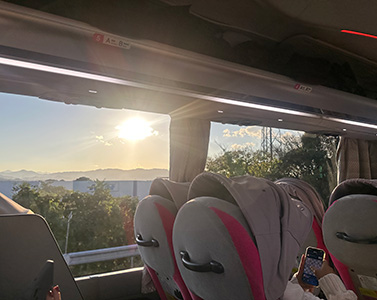
Outside the classroom, I’ve made it a goal to see as much of Japan as I can. I went to Nagano in the autumn with friends to see the snow monkeys, hiking up into the mountains amid the orange and red leaves of early winter. I visited Kyoto in November, Hokkaido at Christmas, Nagoya in February to see friends from my home university, and Atami most recently. Traveling within Japan has been a revelation in itself—the Shinkansen makes distances that would feel impossible to cover in the UK feel reachable(not to mention that it’s a lot cheaper than back home!)
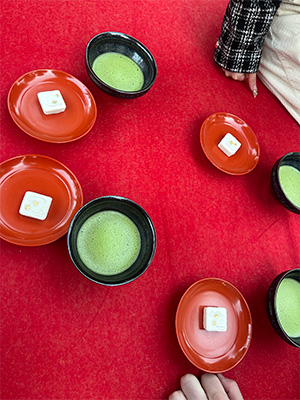 Matcha enjoyed at Kinkaku-ji in Kyoto. Although matcha is popular in the UK, I was struck by the delicate and natural flavor of the matcha I tasted in Japan.
Much like the International Commons, my dorm is genuinely international, and many of my closest friends there are American or European, so we tend to speak English together. The circles of international and Japanese students don’t always overlap as much as I had anticipated, but programs put on by the university have made it easier to make friends with Japanese students. The bonds I have built within my dorm, with people from all over the world, have been some of the unexpected gifts of the year.
 Visiting Yokohama Chinatown with fellow exchange students.
Carrying a quieter confidence into what comes next
The change I feel most clearly in myself after spending nearly a year in Japan is an internal one. Before coming to Japan, I had never flown alone. Flying back to the UK over the break, and then back to Tokyo a month later, was a first for me. So was traveling between Kyoto and Tokyo solo, navigating stations and train platforms in a language I was still learning. Small accomplishments, perhaps, in the grand scheme of things, but they carried a weight that surprised me. I came away from each of them with the quiet thought that I really could navigate my way through the world.
 At Kansai International Airport (KIX) on the journey back from Osaka.
Independence has reshaped how I think about my own capabilities. The skills I picked up here, almost without noticing, are ones that go beyond Japan: organizing my own routines, problem-solving without my parents an hour away, deciding on a weekend trip and just going. I’ve become more socially active in some ways, throwing myself into new experiences and friendships from around the world, while also becoming more comfortable spending time alone, more attentive to the difference between being lonely and being content in my own company.
Looking ahead, I’ll return to Oxford Brookes for my final year of university and continue improving my Japanese alongside other content modules. I would love to continue my Japanese studies and reach a level of conversational fluency. Beyond graduation, I’m not entirely certain what comes next. Media work appeals to me, given my creative background, and so does translation, which I sampled briefly at Oxford Brookes. I can see myself working in the UK, likely London, but I would be happy to consider a placement in Japan someday. The world has felt larger and more reachable since I came here, and I don’t want to close any doors prematurely. Japan has become another country I know how to move through, in my own way, in my own time—and that, more than any single skill or memory, is what I will carry home.
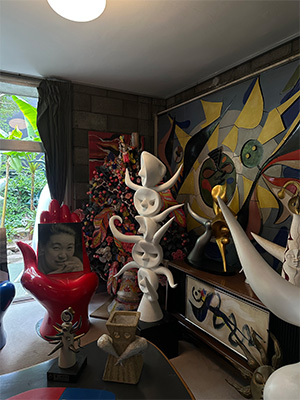 The Taro Okamoto Memorial Museum, just a short walk from AGU. I visited it as part of Topics in Japanese Studies Ⅰ. Although I was unfamiliar with Taro Okamoto before my visit, it was a valuable introduction to modern and contemporary Japanese art.

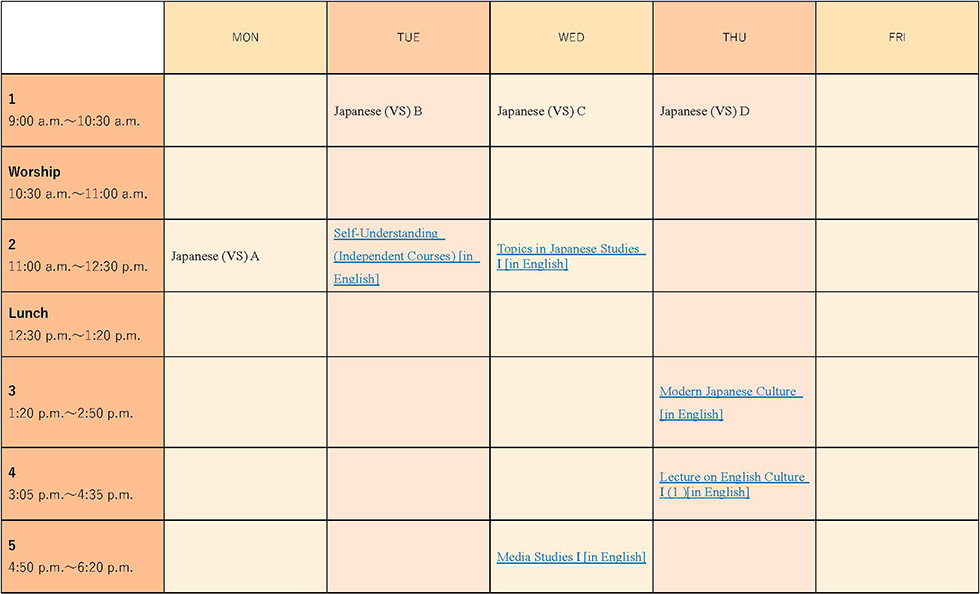
| MON | 2 11:00 a.m.〜12:30 p.m. | Japanese(VS)A |
|---|
| TUE | 1 9:00 a.m.〜10:30 a.m. | Japanese(VS)B |
|---|---|---|
| 2 11:00 a.m.〜12:30 p.m. | Self-Understanding (Independent Courses) [in English] |
| WED | 1 9:00 a.m.〜10:30 a.m. | Japanese(VS)C |
|---|---|---|
| 2 10:30 a.m.〜12:30 p.m. | Topics in Japanese Studies Ⅰ [in English] | |
| 5 4:50 p.m.〜6:20 p.m. | Media Studies Ⅰ [in English] |
| THU | 1 9:00 a.m.〜10:30 a.m. | Japanese(VS)D |
|---|---|---|
| 3 1:20 p.m.〜2:50 p.m. | Modern Japanese Culture [in English] | |
| 4 3:05 p.m.〜4:35 p.m. | Lecture on English Culture Ⅰ(1)[in English] |
Aoyama Gakuin International Center
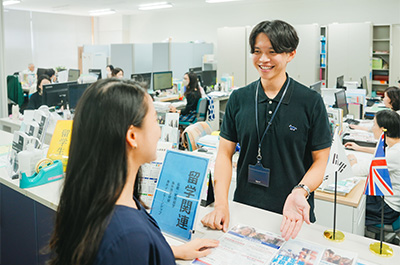
The role of the International Center (IC) at Aoyama Gakuin University is to provide educational support related to the internationalization of the university as well as to help the development of students to become global citizens. The main work of the IC consists of supporting both students going overseas and international students from overseas partner schools and approved institutions; as well as assisting full-time, degree-seeking international students. The worldwide trend of globalization affects not only corporate activities and international relations but should also impact the structure of university education and curricular content. With that in mind, the IC strives to strengthen and expand collaboration between overseas universities and Aoyama Gakuin University while respecting the diverse cultures and traditions of each country as well as the customs and values of our students.